Vegetation patch feature
minecraft:vegetation_patch_feature re-surfaces a rectangle of ground with one block and grows another feature out of every column it keeps. You reach for it when a patch has to follow terrain you did not generate: a clearing of podzol under a grove, a mossy floor in a cave, the moss-and-roots ceiling of a lush cave. It is a Scene feature — unlike a geode, it does not write its own decoration. It finds the ground, lays ground_block into it, and hands each column to the feature named in vegetation_feature.
Where a scatter picks random offsets and lets the delegate work out whether each one is usable, this one searches every column of its footprint for a real surface first, and only the columns that found one get a delegate at all.
Three things decide whether a patch does anything, and all three are easy to get backwards. The footprint is wider than horizontal_radius says and then loses its outer ring; replaceable_blocks is about the solid ground, not the air above it; and vegetation_chance defaults to 0, which grows nothing.
Start here: a complete example
Two files, both complete. The patch re-grasses a square of plains and grows pumpkins on most of it; the block feature it delegates to is the one from the single block page, unchanged.
{
  "format_version": "1.21.110",
  "minecraft:vegetation_patch_feature": {
    "description": { "identifier": "wiki:vegetation_patch_floor" },
    "replaceable_blocks": ["minecraft:grass_block", "minecraft:dirt", "minecraft:stone"],
    "ground_block": "minecraft:grass_block",
    "vegetation_feature": "wiki:pumpkin_patch_block",
    "depth": 1,
    "extra_deep_block_chance": 0.1,
    "vertical_range": 3,
    "vegetation_chance": 0.6,
    "horizontal_radius": 4,
    "extra_edge_column_chance": 0.3,
    "waterlogged": false,
    "surface": "floor"
  }
}{
"format_version": "1.21.110",
"minecraft:single_block_feature": {
"description": { "identifier": "wiki:pumpkin_patch_block" },
"enforce_placement_rules": false,
"enforce_survivability_rules": false,
"places_block": [
{ "block": "minecraft:pumpkin", "weight": 3 },
{ "block": "minecraft:jack_o_lantern", "weight": 1 }
],
"may_replace": ["minecraft:air"],
"may_attach_to": { "bottom": "minecraft:grass_block" }
}
}What each choice buys you:
horizontal_radius: 4withextra_edge_column_chance: 0.3walks an 11×11 rectangle — each drawn radius is used plus one — and keeps its 9×9 interior outright, plus each single-edge column that wins its own 0.3 roll. The four corners are never kept. See the footprint.replaceable_blockslists grass, dirt and stone, the materials the patch is allowed to eat into. It does not list air, and it must not: the cells this list is compared against are solid ground, not the space above it. Seereplaceable_blocks.vegetation_chance: 0.6is what makes this a vegetation patch at all. Left out, it defaults to0and the feature lays its ground layer and stops. Seevegetation_chance.depth: 1plusextra_deep_block_chance: 0.1writes one cell ofground_blockper column, and a second, deeper one about one column in ten.- The delegate is placed in the open cell next to the ground the patch just laid, not at this feature's origin.
wiki:pumpkin_patch_blockstill runs its ownmay_attach_to.bottomcheck there — and passes, because the cell below it is nowminecraft:grass_blockby construction.
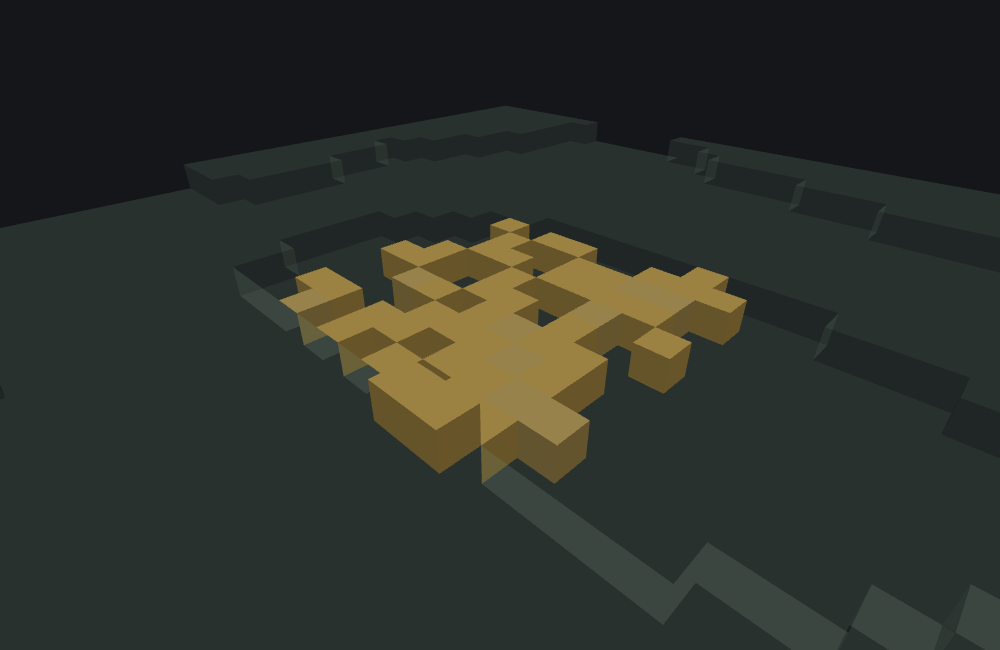
featurelab generate --pack <pack> --feature wiki:vegetation_patch_floor --env plains --seed 1Run against the plains preset with feature seed 1, the call changes 66 cells: 53 pumpkins and jack o'lanterns (51 of them at world y 63, two at y 64 where the terrain steps up), and 13 cells of minecraft:grass_block. The ground layer is much bigger than 13 — it covers every column the patch kept — but almost all of it was already minecraft:grass_block, and a cell that already holds ground_block counts without being rewritten. The 13 that did change are the deeper cells the extra_deep_block_chance roll added, one row further down, and every one of them was minecraft:dirt. The call reports the ground cell of the last column it kept, (5, 62, 3).
A patch on flat ground looks like it did nothing. It did.
This is the commonest surprise with this type: run it on a surface that is already made of ground_block and the ground half of the feature is invisible, because it rewrote nothing. The vegetation is the only visible half. That is also why replaceable_blocks matters even when the patch "looks fine" — a column whose first ground cell is not replaceable and not already ground_block is dropped entirely, vegetation and all.
Fields
Eleven keys, all on the feature body. "Default" is what the game uses when the key is absent. The long-form account of every key, in the editor's own words, is the field reference further down; this table is the short version.
| Key | Required | Value | Default | What it does |
|---|---|---|---|---|
vegetation_feature | yes | feature identifier | — | The feature grown on every kept column, in the open cell beside the ground the patch just laid. Unresolved, the patch is still laid and nothing grows on it. |
ground_block | yes | block descriptor | — | The block the patch's ground layer is made of. Written into the surface, continuing away from the open cell. |
replaceable_blocks | yes | array of block descriptors, at least one | — | Which ground materials may be overwritten. List terrain, not air — see below. |
depth | yes | whole number, [min, max], or {range_min, range_max} | — | How many cells of ground_block each column lays, drawn per column. 0 writes nothing and still keeps the column. See ranges. |
horizontal_radius | yes | the same range shape as depth | — | How wide the patch is, drawn once for x and once for z. Each drawn value is used plus one — see the footprint. |
vertical_range | yes | whole number, at least 1 | — | How far a column may walk to find its surface, in each of the walk's two phases. |
surface | no | floor or ceiling | floor | Which way everything points: the search, the ground fill and the vegetation. See the two values. |
vegetation_chance | no | a probability from 0 to 1 | 0 — never | Rolled per kept column. At the default nothing grows at all — see below. |
extra_deep_block_chance | no | a probability from 0 to 1 | 0 — never | Rolled per kept column; when it hits, the column's ground layer is one cell deeper. |
extra_edge_column_chance | no | a probability from 0 to 1 | 0 — never | Rolled per column on the footprint's outer ring. At the default the whole ring is dropped and the patch is a clean square. |
waterlogged | no | boolean | false | Floods the patch: each ground cell that is enclosed on its four sides and below becomes water, and the vegetation grows in that water. See below. |
The two surface values
surface is a single mirror. It flips the direction the column walk searches, the direction the ground layer fills, and the direction the vegetation grows — all three together, never one without the others.
| Value | What it does | Reach for it when |
|---|---|---|
surface: "floor" | Searches downward for something that can hold the patch on its top face, fills the ground layer downward into it, and grows the vegetation upward. The default when the key is absent. | Anything that sits on the ground: a clearing, a mossy cave floor, a podzol patch under a grove. |
surface: "ceiling" | Searches upward for something that can hold the patch on its bottom face, fills the ground layer upward into it, and grows the vegetation downward. | Anything that hangs: a lush-cave roof of moss with roots below it, a ceiling of nether wart blocks. |
There is no third value. Anything else is not a surface this type has — a wall or a random_horizontal copied over from a snap to surface is not accepted here.
One picture, two files that differ in one word. Both panels start from the same floating origin on the void preset, with a 5×5 stone plate four cells below it and another four cells above it, the same delegate, the same horizontal_radius of 2, the same depth of 1 and the same seed — and nothing but surface changes:
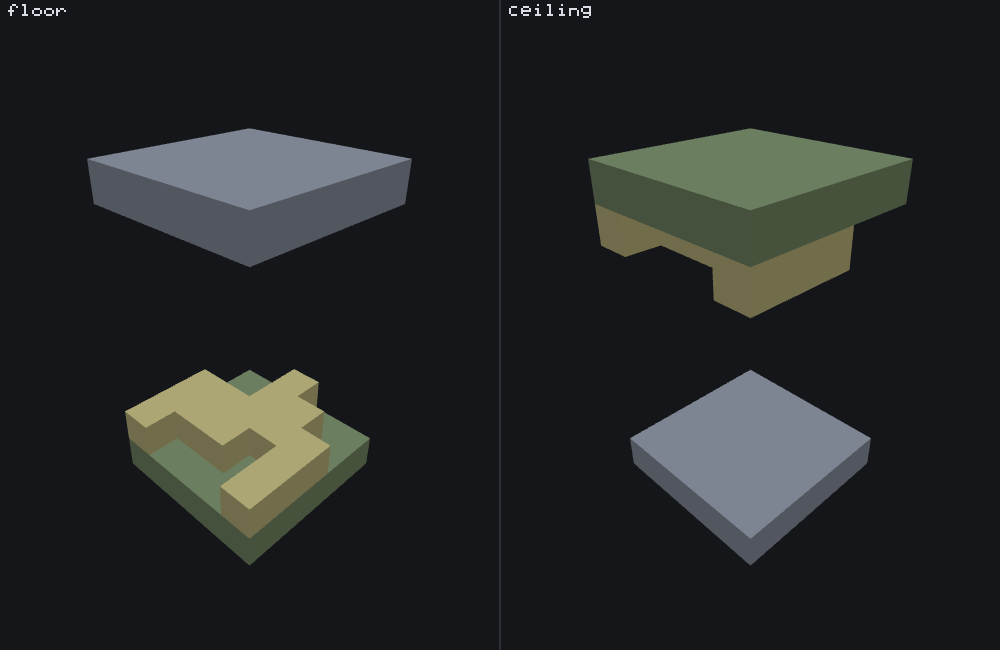
Both panels place exactly 64 cells: 25 cells of stone plate, 25 cells of minecraft:moss_block, and 14 markers. floor walks down, coats the lower plate at y 0, and stands its markers on top of it at y 1. ceiling walks up, coats the upper plate at y 8, and hangs its markers under it at y 7. The plate that the patch ignored is still plain stone in each panel, which is the quickest way to read the picture: the green plate is the one the patch found.
Two things in the figure are chosen for legibility rather than realism, and both matter if you copy it. The plates are one block thick, so a depth of 1 turns a whole plate to moss rather than coating an underside no camera can see. And the delegate is a bare marker that places anywhere, not the moss-attached hanging roots a real ceiling patch uses: a delegate that checks what it is attached to would grow on one surface and not the other, and the empty panel would read as a broken figure rather than as a mirrored one. A ceiling patch in a real pack is further down, with the delegate written the way you would actually write it.
Common mistakes
| You wrote | What happens | Do instead |
|---|---|---|
"replaceable_blocks": ["minecraft:air"] | Every column is dropped unless the ground already happens to be ground_block: the first cell the list is compared against is the solid surface, not the air above it. | List the terrain materials the patch should eat into: ["minecraft:stone", "minecraft:dirt", "minecraft:grass_block"]. |
No vegetation_chance at all | The ground layer is laid and nothing grows on it. The feature succeeds, so nothing reports a problem. | Write the probability you want, from 0 to 1. |
"horizontal_radius": 4 expecting a 9×9 footprint | It walks 11×11 — the drawn radius is used plus one — and then the default extra_edge_column_chance of 0 drops that outer ring, leaving 9×9. You get the size you expected by a route that surprises you the moment you set an edge chance. | Nothing, if 9×9 is what you want. Set extra_edge_column_chance above 0 deliberately, knowing it unlocks a ring one block further out than the number you wrote. |
"extra_edge_column_chance": 1 expecting a full square | The four corners are dropped whatever this says. The footprint is 11×11 minus its four corners. | Nothing — there is no way to keep a corner. |
"depth": [1, 3] expecting a depth of 3 | The top of a range is exclusive: this gives 1 or 2. | [1, 4]. |
"depth": {"min": 1, "max": 3} | This type reads range_min/range_max only. The game reports the object and quietly uses a zero-width range, so the file loads and the patch is not the depth you wrote. | {"range_min": 1, "range_max": 4}, or the [1, 4] array. |
"waterlogged": true with a delegate that only replaces air | The patch floods, and nothing grows in it: the vegetation is placed in the water cell, where a delegate whose may_replace is ["minecraft:air"] refuses. See below. | Give the delegate's may_replace minecraft:water, and check its attach rules against the block under the water. |
"surface": "wall", copied from a snap-to-surface feature | Not a value this type has. The game reports Bad value for surface - should be 'ceiling' or 'floor', and featurelab refuses the file rather than picking a direction for you. | floor or ceiling. For the four side directions you want snap to surface. |
A vegetation_feature no loaded file defines | The whole ground patch is still written and nothing grows on it — the feature reports success. | featurelab check reports the reference by name, with a near-match suggestion, before you ever run it. |
"vertical_range": 0 | Refused: the field's own minimum is 1. | At least 1, and in practice at least the distance from the origin to the surface you mean. |
| Expecting the patch to follow a cliff | Each column walks at most vertical_range cells, from the origin's own height, not from its neighbour's. A column whose surface is further away than that is dropped, so a patch across a step comes out with a bite taken out of it. | Raise vertical_range, or place the patch where the terrain is within it. |
How it runs
- Work out the footprint. A radius is drawn for x and another for z, independently, from
horizontal_radius— so a genuine range gives a rectangle rather than a square. Each drawn value is then used plus one. - Walk every column of that rectangle — every
(dx, dz)offset inside it. A corner column — at the extreme on both axes — is always dropped. A column on exactly one edge is dropped too, unlessextra_edge_column_chanceis above0and its roll succeeds. - Find the surface, from the origin's own height, in up to two phases. While the cell is open, step toward the surface — down for
floor, up forceiling— at mostvertical_rangetimes. Then, if that ended on a cell that is not open, which is what a column buried in the ground looks like, step back the other way while the cells stay solid, again at mostvertical_rangetimes. A column still buried after all that is dropped. - Check the ground cell — the solid cell one step further in the search direction, past the open cell the walk stopped in. It has to be a block that can hold something on the face the walk arrived at: its top face for
floor, its bottom face forceiling. Most full blocks can; open shapes like fences, torches and rails cannot. A column whose ground cell fails this is dropped. - Write the ground layer.
ground_blockgoes into that cell and intodepth - 1further cells past it, continuing into the solid — plus one more whenextra_deep_block_chancehits. A cell that already holdsground_block, in any of its states, counts without being rewritten; a cell listed inreplaceable_blocksis overwritten; anything else stops the fill there, and drops the column only if that happened on the very first cell. Adepthof0writes nothing and keeps the column. - With
waterlogged, flood it. Every kept column whose ground cell is exposed — any of its four side neighbours or the block under it unable to hold it — is dropped, with no water. Every other one has its ground cell replaced byminecraft:water. See below. - Grow the vegetation. Only when every column has been walked does the second pass begin: for each kept column, roll
vegetation_chance, and on success runvegetation_featurein the open cell from step 3 — one above the ground forfloor, one below it forceiling. Withwaterlogged, one block lower: in the water cell itself forfloor, two below the ground cell forceiling. The delegate runs its own checks there and may still refuse; nothing retries. - Report. At least one kept column is a success, and the position reported is the ground cell of the last column kept in walk order. No kept columns at all is a failure, with
Vegetation could not be placed.
Like every type that delegates, this feature also goes through an internal-feature check, which refuses with Cannot place internal feature — a fixed permission about the types the game reserves for itself, not a loop check. It is checked after the ground layer has been written, so a refusal would leave the patch's ground in the world and report failure anyway; a feature loaded from a pack always passes it, though. See delegation loops.
The footprint: horizontal_radius is wider than it says
Two separate surprises stack here, and they very nearly cancel.
Each drawn radius is used plus one. A horizontal_radius of r walks a rectangle 2r + 3 columns on a side, not 2r + 1: with horizontal_radius: 4 the walk runs from -5 to 5 on each axis, 2×(4+1) + 1 columns, an 11×11 rectangle. A horizontal_radius of 0 is still a 3×3 walk.
The outer ring of that widened rectangle is what extra_edge_column_chance gates, and it defaults to 0. So with the key left out, the ring is dropped in full and what survives is the 2r + 1 interior — 2×4 + 1 columns per axis for that same horizontal_radius: 4 — exactly the size you would have guessed from the number you wrote. A horizontal_radius of 4 keeps a 9×9 interior, 81 columns against flat ground; a horizontal_radius of 2 keeps 5×5, 25 columns, which is the figure and is what both of its panels measure.
The two surprises stop cancelling the moment you set an edge chance. extra_edge_column_chance: 1 on that horizontal_radius: 4 patch does not fill in the 9×9 — it unlocks the 11×11 ring, giving 121 columns minus the four corners, which are dropped whatever the chance says. The jump is from 81 to 117, not from 81 to 121 and not from 81 to something slightly over 81.
Two more details worth keeping:
- The two radii are drawn independently, one for x and one for z. With a genuine range they differ, so the footprint is a rectangle; a bare number gives a square every time.
- Nothing here is circular. The footprint is a rectangle with its corners cut, not a disc, at every radius.
replaceable_blocks is about the ground, not the air
The cell the ground layer starts at is the solid one past the air the column walk stopped in — the floor block under it, or the ceiling block over it. That is the cell compared against replaceable_blocks, and it is why a list containing only minecraft:air can never replace anything: the first cell it is asked about is never air, so every column stops on its very first cell and is dropped. The patch places nothing, anywhere, and reports Vegetation could not be placed.
List what the terrain is actually made of. For a floor on plains that is minecraft:grass_block, minecraft:dirt and minecraft:stone; for a lush-cave ceiling it is minecraft:stone, and the moss replaces the stone rather than coating its underside.
Within a column the fill is not all-or-nothing:
- A cell that already holds
ground_blockcounts towarddepthwithout being rewritten. This is why a patch on ground that already matches looks like it did nothing. - A cell listed in
replaceable_blocksis overwritten and counts. - Anything else stops the fill there. The column is dropped only if that happened on its first cell; a column that wrote one cell and then hit bedrock is a kept, partly filled column.
vegetation_chance, and the patch that grows nothing
vegetation_chance defaults to 0, which means never. A patch that omits it lays its whole ground layer, keeps every column, reports success — and grows not one of the things its own name promises. Nothing warns you, because nothing went wrong.
It is rolled once per kept column, in a second pass after the entire ground patch has been laid, so the number of things that grow follows the number of columns the patch kept, not the number of cells it rewrote. In the worked example a chance of 0.6 produced 53 placements.
The other two probabilities behave the same way and have the same default of 0: extra_deep_block_chance is rolled per kept column and adds exactly one cell when it hits, and extra_edge_column_chance is rolled per single-edge column and is the only thing that can keep the outer ring.
depth and horizontal_radius: how a range is read
Both fields take the engine's range shape: a bare number, a two-element [min, max] array, or a {range_min, range_max} object.
- The top of the range is exclusive.
[1, 4]gives 1, 2 or 3.[1, 3]gives 1 or 2. - A range that spans at most one value is a constant. A bare number,
[3, 3]and[3, 4]all give exactly3— for[3, 4], because the exclusive top leaves3as the only possibility. - The key names are
range_minandrange_max. The{min, max}spelling the geode page's own ranges use is not read here: the game reports the object and substitutes a zero-width range, so the file loads in game and the field silently is not what you wrote. featurelab refuses it instead, and says so.
waterlogged
waterlogged: true turns the patch into a pool. The ground patch is built exactly as without it — every roll, every ground write — and then each kept column is tested once more:
- A column is exposed when one of five neighbours of its ground cell cannot hold it: the four side neighbours and the block underneath. The block above is never looked at. An exposed column is dropped: its ground layer stays, it gets no water, and it takes no
vegetation_chanceroll. - Every other column has its ground cell replaced by
minecraft:water. The ground layer's top cell is the one that turns to water, so adepthof1leaves no ground block under the pool at all, only what was already there. - The vegetation then grows in the water cell for
floor— one block lower than a dry patch — and two below the ground cell forceiling.
All the exposure tests are made before any water is written, so the pool's own water never makes a neighbour exposed. A patch whose every column is exposed fails with Vegetation could not be placed, after writing its ground layer. That is what a ceiling patch over open air always does: every ground cell has the open cell below it.
The delegate is the part to check. Turning this key on in your own copy of the worked example and re-running its command floods 90 columns at y 62 — the whole kept footprint, since every edge column is still surrounded by grass — and turns the same 13 dirt cells at y 61 into grass, and grows no pumpkins at all: the pumpkin delegate's may_replace is ["minecraft:air"] and its may_attach_to wants grass underneath, and the cell it is offered is water over dirt. A delegate meant for a waterlogged patch has to accept water in its own cell.
Building a ceiling patch
The lush-cave shape — a stone roof whose underside becomes moss, with something hanging from it — is what surface: "ceiling" exists for, and it needs three things to line up:
features/vegetation_patch_ceiling.json{
"format_version": "1.21.110",
"minecraft:vegetation_patch_feature": {
"description": { "identifier": "wiki:vegetation_patch_ceiling" },
"replaceable_blocks": ["minecraft:stone"],
"ground_block": "minecraft:moss_block",
"vegetation_feature": "wiki:hanging_roots_ceiling_block",
"depth": 1,
"extra_deep_block_chance": 0.1,
"vertical_range": 6,
"vegetation_chance": 0.8,
"horizontal_radius": 4,
"extra_edge_column_chance": 0.3,
"waterlogged": false,
"surface": "ceiling"
}
}replaceable_blockslists what the roof is made of, hereminecraft:stone. The moss replaces the bottom layer of the stone; it is not a coat hung underneath it. A ceiling patch whosereplaceable_blocksdoes not contain the roof material keeps no column at all.- The delegate attaches to the ground block from the other side.
wiki:hanging_roots_ceiling_blockis a single block feature placingminecraft:hanging_rootswithmay_replace: ["minecraft:air"]andmay_attach_to.topset tominecraft:moss_block—top, because for something hanging, the block it hangs from is the one above it, and it is the mirror of the floor example's ownmay_attach_to.bottom: "minecraft:grass_block". vertical_rangereaches the roof. The walk starts at the origin's own height and goes up; six cells is enough for a roof up to six above the origin and not one cell more.
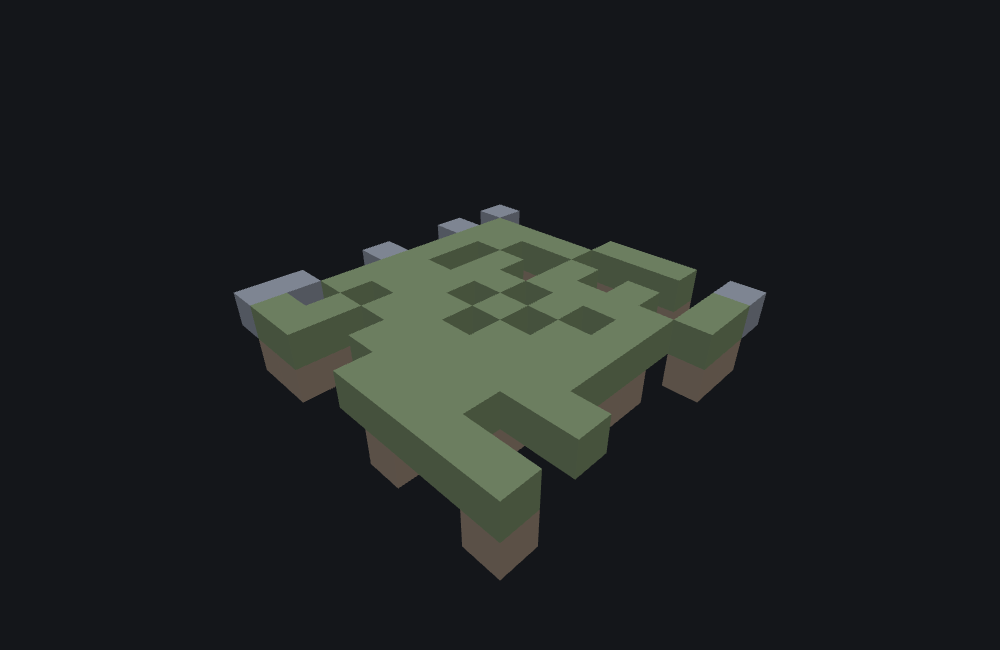
featurelab generate --pack <pack> --feature wiki:vegetation_patch_ceiling_demo --env void --seed 1 --origin 0,10,0The picture runs this file on the void preset, wrapped in an aggregate with a helper scatter that first lays a slab of minecraft:stone five blocks above the origin, purely so there is a roof to patch at all — that scatter is scaffolding for the illustration, not part of the type. At feature seed 1, from an origin of (0, 10, 0), the result is 105 cells: 63 cells of scaffolding stone, of which the ceiling scan turns 57 into minecraft:moss_block (the six the scan never reached stay stone), and 42 cells of minecraft:hanging_roots growing downward from the columns that won their vegetation_chance roll.
Field reference
The long-form account of every key, generated from the editor's own catalogue — the same text the Feature Lab node editor shows in its ? pane and on hover, with the schema facts (required, kind, absent-key default) the editor's forms are built from. The table above is the summary; where the two differ in precision, the table is the measured version.
vegetation_feature
required · feature identifier · edited on the connection, not in the form
The feature grown on every column the patch keeps.
A namespace:id that some file in the pack defines. It is placed in the open cell next to the ground the patch just laid -- above it for floor, below it for ceiling -- never at this feature's own origin, and it runs its own attachment checks there like any other delegate. The reference is resolved once, after the ground layer has already been written, so a file naming a feature nothing defines still lays its whole patch of ground_block and simply grows nothing on it; featurelab check reports the reference itself, with a near-match suggestion, without running anything. The internal-feature check is different again: when it refuses, the ground layer has been written and the call reports failure anyway.
replaceable_blocks
required · blockList
The blocks the patch may dig its ground layer into.
A column stops filling at the first block that is neither ground_block nor in this list. A column that could not fill even one cell is dropped, so an over-narrow list quietly shrinks the patch.
Must be non-empty.
ground_block
required · block
The block the patch's ground layer is made of.
Written downward from the supporting cell, depth cells deep.
depth
required · range
How many cells of ground_block each column lays down.
Drawn per column from this range. A depth of 0 still keeps the column and still grows vegetation on it -- it just writes no ground.
horizontal_radius
required · range
How wide the patch is, drawn separately for x and z.
The patch is wider than this number suggests: each drawn radius is used plus one, so a horizontal_radius of 0 is still a 3x3 patch. The extra outermost ring is the one extra_edge_column_chance gates, and the corners are always trimmed.
vertical_range
required · number · range [1, −]
How far a column may search up or down for the ground.
Used twice: first descending while the cells are open, then climbing back out if that landed inside solid ground. A column that is still buried after that many steps is dropped.
surface
optional · enum · absent: floor
Whether the patch grows from the floor or hangs from the ceiling.
It flips the direction of the search, of the ground fill and of the vegetation together.
Values, in the order the engine lists them:
floor— The patch sits on the ground and its vegetation grows upward. Columns search downward for something that can support the patch, and the ground layer fills downward into it.ceiling— The patch clings to a ceiling and its vegetation hangs downward. Every direction is mirrored: columns search upward, the ground layer fills upward, and the vegetation grows down.
vegetation_chance
optional · number · absent: 0.0
Chance to grow the attached feature on any one ground cell.
Mind the default: 0 means NO vegetation at all -- the patch lays its ground layer and nothing else. Rolled per cell.
extra_deep_block_chance
optional · number · absent: 0.0
Chance for a column to dig one cell deeper than depth.
Rolled per column, and adds exactly one cell when it hits.
extra_edge_column_chance
optional · number · absent: 0.0
Chance for a column on the patch's outer ring to be kept.
Only the single-edge columns are gated -- corners are always dropped and the interior is always kept. At 0 the patch is its interior only, with a clean square edge.
waterlogged
optional · boolean · absent: false
Floods the patch: its enclosed ground cells become water, and the vegetation grows in the water.
The ground patch is built as usual; then a column whose ground cell has an open side or an open cell below it is dropped, and every other column has its ground cell replaced by water. The vegetation is placed one block lower than on a dry patch -- in the water cell for a floor patch -- so the delegate has to be allowed to replace water.
What the bench does differently
This page documents the game. Three things belong to the featurelab bench used to illustrate it:
- A
{min, max}range is refused at load rather than quietly replaced. Given{"min": 1, "max": 3}fordepthorhorizontal_radius, the game reports it and substitutes a zero-width range, so the file loads and the field is not what its author wrote. The bench refuses the file and names the spelling, on the grounds that a field that silently is not what you wrote is the worst way for it to be wrong. - A
surfacevalue outsidefloorandceilingis refused at load. The bench will not pick a direction its author did not write. - Two strictnesses are the bench's own and are not confirmed against the game:
replaceable_blocksmust be a non-empty array, andvertical_rangemust be at least1. A file that breaks either is refused here; whether the game refuses it or falls back is not something this page states.
Everything else about this type — both surface directions, the widened radius, the two-phase column walk, the support test on the ground cell, the counted-not-rewritten cell, the depth: 0 column and the order the two passes run in — is implemented and measured.
Advanced: what this type costs the random stream
You do not need this section to use a vegetation patch. It is for reading a preview value for value against the game, or for reproducing the engine exactly. RNG and determinism is the model these numbers fit into; this is this type's row in it.
The type's own draws, in the order a call takes them:
| When | Cost | Which kind |
|---|---|---|
| Once per call, before anything else | 0 or 2 | The horizontal_radius range, sampled twice — x then z. See the int-range rule below. waterlogged adds no draws of its own. |
| Per single-edge column of the footprint | 0 or 1 | One float draw, and only when extra_edge_column_chance is not exactly 0. The guard is an exact compare against zero, so a negative chance still spends the draw here and then always skips the column. Corners and interior columns cost nothing. |
| Per column that found its surface | 0 or 1 | One float draw for extra_deep_block_chance, taken only when that value is above 0. |
| Per column that found its surface | 0 or 1 | The depth range. Taken after the extra-deep roll, never before it. |
| Per kept column, in the second pass | 0 or 1 | One float draw for vegetation_chance, taken only when that value is above 0 (with waterlogged, only for columns that were not exposed) — and taken even when vegetation_feature resolves to nothing, so an unresolved delegate does not move the stream. |
The int-range draw, shared with tree and growing plant: over (min, max) it returns min and spends nothing when min >= max - 1, and otherwise spends exactly one bounded integer draw of max - min added to min — uniform over [min, max - 1]. That is the whole reason max is exclusive, and why [3, 4] is a constant rather than a coin flip. It is not the same as the min/max ranges on the geode page, which disagree with it at exactly this boundary.
The two passes are separate, and that is what fixes the order of everything above: every column's edge, extra-deep and depth draws are taken while the ground patch is being built, and only then does the vegetation pass take one draw per kept column. Nothing interleaves them. A delegate's own draws therefore all come after the last ground draw, never between two of them.
Walk order is x outer, z inner, each ascending from -span to +span, and the position the feature reports is the last kept column's ground cell — (5, 62, 3) for the worked example, which is the dx = +5 edge column at dz = +3.
See also
- Single block feature — the delegate both of this page's examples use, and the most common
vegetation_featuretarget in real packs. Itsmay_attach_to.<face>is what makes a ceiling delegate attach upward. - Geode feature — the other Scene feature in this version, and the contrast: it writes its own content instead of delegating, and its
min/maxranges are read differently from this page's. - Scatter feature — random offsets instead of a real per-column surface search, and the Proxy type this page's ceiling scaffolding is built from.
- Growing plant feature — a column that grows up or down from one point, which is what a
vegetation_featureoften is on a ceiling patch. - Feature rules — how any of this reaches a world: a feature file is inert until a rule attaches it to the chunks of the biomes it belongs in.
- RNG and determinism — the model the per-column rolls above fit into.
How this page was checked
Everything above is a statement about Bedrock 1.26.60.22, and holds for 1.26.50.24 and 1.26.40.26 too: this type's JSON surface — every key, enum value and default — and its behaviour are identical in all three.
The widened radius, the corner and edge trimming, the two-phase column walk, the support test on the ground cell, the counted-not-rewritten cell, the depth: 0 column, the exclusive top of a range and the two-pass order are stated as facts about the game. The worked example was run end to end and its changed cells read back out of featurelab generate before the prose was written: 66 cells, 13 of them minecraft:dirt turning into minecraft:grass_block one row below the ground layer, 53 of them pumpkins and jack o'lanterns, and a reported position of (5, 62, 3). The waterlogged figures are a control run of that same command with the one key changed: 103 cells, 90 of them minecraft:grass_block turning into minecraft:water at y 62 and the same 13 dirt cells turning into grass, the same reported position, and no pumpkins. The ceiling example was run the same way: 105 cells, 57 moss and 42 hanging roots, with six scaffolding stone cells the scan never reached. The floor-against-ceiling figure's two panels were each run the same way and their changed-cell coordinates read before the caption was written: 64 cells in both, 25 stone plus 25 minecraft:moss_block plus 14 markers, with the moss at y 0 and the markers at y 1 for floor and at y 8 and y 7 for ceiling — and the same 14 columns growing in both panels, because the two files spend the same values in the same order. All three images were rendered from those exact results by the documentation's own image pipeline, which runs the real engine against the fixtures and the documentation's own pack with a fixed seed and a deterministic camera, so re-running it reproduces each picture byte for byte, and which refuses a figure whose panels come out nearly identical.
The example fixtures are committed under docs/wiki/tools/fixtures/features/: vegetation_patch_floor.json for the worked example, and vegetation_patch_ceiling.json with its hanging_roots_ceiling_block.json delegate and the vegetation_patch_ceiling_demo.json scaffolding for the ceiling example. The figure's own scenes are in the documentation's pack, docs/wiki/tools/figure-fixtures/features/ — veg_panel_floor.json and veg_panel_ceiling.json — two aggregates that lay the two plates and then run veg_panel_patch_floor.json / veg_panel_patch_ceiling.json, which differ in the word floor and nothing else — over the shared veg_panel_slab_grid.json plate and the threshold_marker.json delegate. featurelab check is clean on all of them.
What is uncertain is named where it is relevant and collected in what the bench does differently: the refusal of the {min, max} spelling and of a third surface value where the game reports and carries on, and the two load-time strictnesses that are the bench's own.