Scan surface
minecraft:scan_surface runs one wrapped feature at the surface of every column of a chunk — all 256 of them. You reach for it when something should cover ground wall to wall rather than dot it: a carpet of moss over a whole chunk, snow on every exposed column, a sweep that lets the delegate itself decide which columns qualify. It places nothing of its own, which makes it a Proxy feature — it produces positions and hands each one to places_feature.
Where a scatter picks a handful of random offsets and leaves gaps between them, this one skips nothing: every column of the chunk gets a real placement attempt, with real consequences. That is the whole difference between the two, and it is a difference of intent, not of quality — a sparse patch and a wall-to-wall cover are different jobs.
Two things need saying before anything else. The id has no _feature suffix, and there is no alias — see the note below. And Microsoft's own Bedrock Creator reference classifies this type as internal or deprecated, the same caveat conditional list used to carry. Published packs use it anyway, and in this version it works exactly like any other feature type; documenting it is a statement about what the game does, not a recommendation from Mojang.
The id is `minecraft:scan_surface` — no `_feature` suffix
There is no minecraft:scan_surface_feature to fall back on if you type the suffix out of habit, and no alias: "scan_surface_feature" is not a JSON type id and will never work as a component key. A file that uses the suffixed name names a type the game does not have, and does not load. The suffixed spelling does appear inside the game — as a label on log lines — which is exactly why the mistake is easy to make.
Start here: a complete example
Two files, both complete. The scan runs a single-block feature at every column of its chunk; the block feature is the one from the single block page, unchanged.
{
  "format_version": "1.21.110",
  "minecraft:scan_surface": {
    "description": { "identifier": "wiki:scan_surface_pumpkins" },
    "places_feature": "wiki:pumpkin_patch_block"
  }
}{
"format_version": "1.21.110",
"minecraft:single_block_feature": {
"description": { "identifier": "wiki:pumpkin_patch_block" },
"enforce_placement_rules": false,
"enforce_survivability_rules": false,
"places_block": [
{ "block": "minecraft:pumpkin", "weight": 3 },
{ "block": "minecraft:jack_o_lantern", "weight": 1 }
],
"may_replace": ["minecraft:air"],
"may_attach_to": { "bottom": "minecraft:grass_block" }
}
}What each choice buys you:
places_featureis the only key there is. This type has no radius, no count, no chance and no filter: the area is always one whole chunk, and every column in it is always attempted. If you want fewer, the filtering belongs in the delegate — see choosing which columns qualify.- The delegate is given each column's own surface position, not this feature's origin. The pumpkin lands wherever that column's ground is, so a cover follows rolling terrain rather than sitting at one height.
- The delegate's own rules still apply at every one of those positions.
wiki:pumpkin_patch_blockrefuses a column whose ground is not grass, and 256 attempts with 200 refusals is a perfectly ordinary, healthy result.
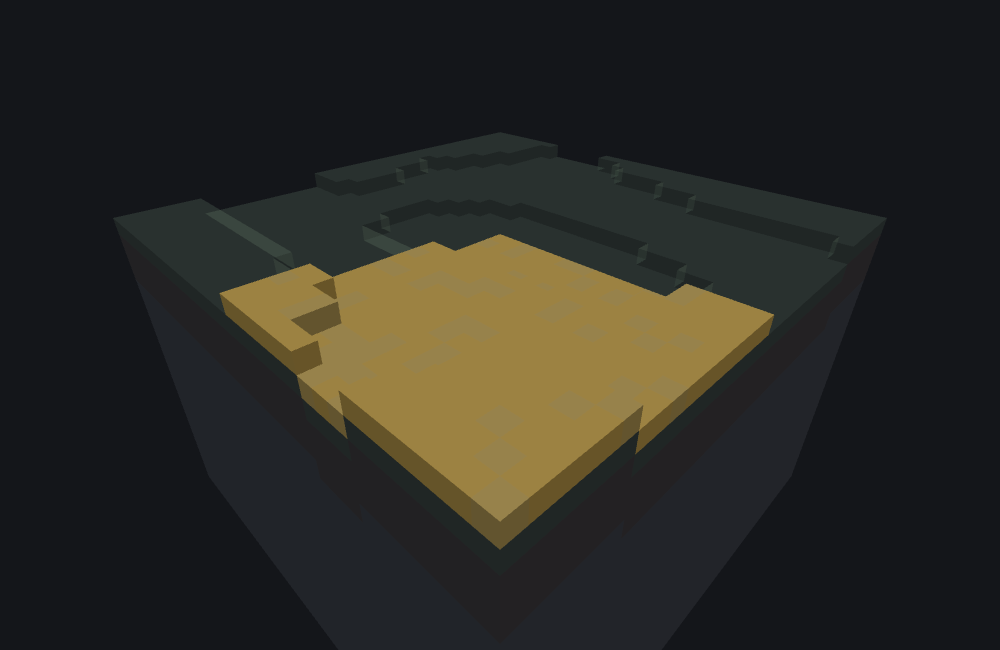
featurelab generate --pack <pack> --feature wiki:scan_surface_pumpkins --env plains --seed 1Run against the plains preset with feature seed 1 and the default origin, this attempts all 256 columns of the chunk (0..15, 0..15). The preset's grass is unbroken, so every attempt succeeds and 256 blocks change — the cover follows the surface up and down as it goes, between y 63 and y 65 in this shot. The last column visited, (15, 65, 15), is what the call hands back.
Compare that with the scatter page's own pumpkin patch on the same terrain: 14 randomly offset attempts, 12 of them succeeding, with visible ground between them. Same delegate, same preset, same seed, and two entirely different pictures.
Fields
One key, on the feature body. The long-form account of it, in the editor's own words, is the field reference further down.
| Key | Required | Value | Default | What it does |
|---|---|---|---|---|
places_feature | yes | feature identifier | — | The feature run once at every column of the chunk. A name nothing defines fails the whole call before a single column is visited. See the note on this key's spelling. |
There is no key for the area, the step, the order or the count: all four are fixed. A chunk is always 16 by 16, every column is always attempted, the order is always the same, and there is no way to ask for a subset.
The name of this key is this page's one uncertainty
places_feature is the best-known spelling, not a confirmed one
Everything on this page about what the type does is measured. The exact JSON key name for its one field is not: the placement needs a single feature reference and the name it is written under could not be confirmed. places_feature is used here because it is what scatter calls the field of the identical purpose. If a file of yours will not load, that key is the thing to suspect first — and nothing else on this page depends on it. See what the bench does differently.
Common mistakes
| You wrote | What happens | Do instead |
|---|---|---|
"minecraft:scan_surface_feature" as the type key | The file names a type the game does not have and does not load. | "minecraft:scan_surface". |
| A heavy delegate — a tree, a big structure | It runs 256 times per placement, and again for every placement the rule makes. This is the commonest way to make a pack generate slowly. | Keep the delegate cheap, or use a scatter for something you want a handful of. |
| Expecting a 16×16 area centred on the origin | The area is the chunk the origin falls in. An origin at x 20 covers x 16 to x 31: twelve columns to its west and eleven to its east. | Place it anywhere in the chunk you mean; where in the chunk makes no difference. |
| Expecting the returned position to mean "where it worked" | It is whichever column succeeded last in the fixed walk, which is very often the far corner and says nothing about the rest. | Do not build on the returned position unless you know the walk order. |
| Chaining it as the first entry of a sequence | The next entry inherits that far-corner position, not the origin you started from. | Put the scan last, or wrap it so its return value is not threaded on. |
| Expecting a diagnostic for each column that refused | There is none, for any of them. 256 quiet refusals and 256 quiet successes look the same from outside. | Run the delegate on its own at a known position to see why it refuses. |
| A delegate that reads Molang variables another feature wrote | All 256 columns share one variable scope, so a variable the delegate writes on column 3 is still there on column 4. | Have the delegate set what it reads, or do not rely on the scope being fresh. |
How it runs
- Resolve
places_feature. A name no loaded file defines fails the entire call, with no column visited and nothing placed. - Check the internal-feature permission. This is a fixed check on whether the feature may place one of the types the game reserves for itself, not a record of what is running. A feature loaded from a pack always passes it, and it does not stop a delegation loop.
- Work out the chunk. Not a box around the origin: the 16 by 16 chunk the origin's own
(x, z)falls in, aligned to multiples of 16. - Walk every column,
xascending on the outside andzascending on the inside. Nothing is skipped, nothing is sampled, and nothing ends the walk early — not a failure, not a success, not a hundred failures in a row. - For each column, read its surface height, build a position at
(x, height, z)and run the delegate there. Whatever it does is real: blocks written on column 5 are there to be read on column 6. - Remember the last success. Each column that succeeds overwrites the remembered result rather than adding to it.
- Hand back that last remembered position, or nothing at all if every one of the 256 refused.
Which chunk it covers
The area is the chunk containing the origin, not an area measured from it. Both coordinates are rounded down to a multiple of 16 and the walk covers that and the next fifteen on each axis. Three worked cases, all run:
| Origin | Columns covered | Last column visited |
|---|---|---|
(0, *, 0) | x 0–15, z 0–15 | (15, *, 15) |
(20, *, 20) | x 16–31, z 16–31 | (31, *, 31) |
(-1, *, -1) | x −16–−1, z −16–−1 | (-1, *, -1) |
Negative coordinates round down, not towards zero, so x −1 belongs to the chunk that starts at −16 — the same rule the game uses everywhere else for chunks. The practical consequence: moving this feature's origin one block can move the whole cover sixteen blocks, if that one block crosses a chunk boundary. Moving it fifteen blocks inside the same chunk changes nothing at all.
What it hands back, and why that matters
Every column that succeeds replaces the remembered result. Nothing accumulates, nothing is averaged, and the first success is not special — the value handed back is the position of the last column that worked, in the fixed x-then-z walk. Conditional list follows the same last-success-wins rule, and for the same reason: there is one slot for a result and every success writes to it.
For most packs this never comes up, because a feature rule ignores what a feature returns. It comes up sharply in a sequence, where each entry starts from the position the previous one returned: put a scan in the middle of a sequence and everything after it starts from the far corner of the chunk, which is almost never what was meant.
If every column refused, the call reports nothing at all — the same outcome as a delegate that placed nothing anywhere.
Choosing which columns qualify
This type has no filter of its own, and that is by design: the judgement belongs to the delegate, which is given a real position and can refuse it. Three ways to narrow a cover:
- The delegate's own placement rules. A single block feature's
may_replaceandmay_attach_toalready refuse columns whose ground is wrong, which is what the example above relies on. - A conditional list as the delegate, when the test is about where the column is — a height, a Molang variable — rather than what is under it.
- A height difference filter as the delegate, when the test is about the shape of the ground around the column: a cover that appears only on slopes, or only away from cliffs.
All three run 256 times, so a cheap test is worth more here than anywhere else.
Field reference
The long-form account of every key, generated from the editor's own catalogue — the same text the Feature Lab node editor shows in its ? pane and on hover. The table above is the summary.
This type has no fields of its own beyond its delegation keys: everything it accepts is a reference to another feature, drawn on the graph as a connection rather than a form field.
places_feature
required · feature identifier · the field name itself is not confirmed · edited on the connection, not in the form
The feature run once at the surface of every column of the chunk.
A namespace:id that some file in the pack defines. It is the only field this type has: the area is always one whole 16x16 chunk, every column in it is always attempted, and nothing can narrow that from here -- a delegate that refuses is how a cover is narrowed. Unresolved, the whole call fails before a single column is visited. The KEY NAME is the one uncertain thing about this type: places_feature is used because that is what a scatter calls the field of the identical purpose, and this tool additionally accepts feature and feature_to_scan defensively, where the game accepts exactly one of the three.
What the bench does differently
This page documents the game. Three things belong to the featurelab bench used to illustrate it:
- The bench accepts three spellings of the one field, where the game accepts one.
places_feature,featureandfeature_to_scanall load here. That is deliberate defensiveness about a key name that could not be confirmed, not a claim that the game is generous: in the game exactly one of them is right and the other two do not load. This is the page's one real uncertainty, and it is flagged in the Fields section as well. - The surface height is the bench's own terrain reading rather than the game's own surface concept — the same substitution the surface relative threshold page documents, and it applies to every one of the 256 columns identically.
- 256 delegations per placement is a real cost here too. A scan whose delegate is expensive will hit the bench's own placement budget and come back partial, with a diagnostic saying so. That is the bench protecting itself, not the game refusing anything.
Advanced: what this type costs the random stream
You do not need this section to use a scan surface feature. It is for reading a preview value for value against the game, or for reproducing the engine exactly. RNG and determinism is the model these numbers fit into; this is this type's row in it.
This type spends nothing of its own. No draw is taken to choose a column, an order or a position — all three are fixed — so every value consumed during a call belongs to the delegate. What it does do is multiply: a delegate that spends n values per attempt spends 256n here, in the order of the walk, and a column that refuses still costs whatever the delegate spent before refusing. That makes this the type where a delegate's own draw accounting matters most, because it is paid 256 times over and everything after it in the same pass is shifted by the total.
The chunk bounds are floor(originX / 16) * 16 and floor(originZ / 16) * 16 through +15 on each axis — ordinary chunk-local arithmetic, with the floor rounding down rather than towards zero. The walk is x ascending on the outside, z ascending on the inside. Each column's position is (x, height(x, z), z). The Molang scope handed to every column is the same object, not a copy and not a child: a variable one column's delegate writes is readable by the next one, and by whatever runs after the scan.
See also
- Scatter feature — the sparse, random alternative to this type's exhaustive cover, contrasted directly above; also the page whose
places_featurethis type's field name was taken from. - Conditional list — the other type in this set that Microsoft's reference calls internal, and the one that shares this type's last-success-wins return rule.
- Height difference filter — a gate to put under a scan when only some columns should be covered.
- Single block feature — the delegate this page's example reuses verbatim, and where its per-column refusals come from.
- Sequence feature — why a scan's returned position is worth knowing about: a sequence threads it into the next entry.
- Feature rules — how any of this reaches a world: a feature file is inert until a rule attaches it to the chunks of the biomes it belongs in.
How this page was checked
Everything above is a statement about Bedrock 1.26.60.22, and it holds for 1.26.50.24 and 1.26.40.26 too: this type's JSON surface and its placement are unchanged across the three.
The chunk alignment, the fixed x-then-z walk with no skipping and no early exit, the last-success-wins return value, the shared Molang scope and the absence of any field but the feature reference are stated as facts about the game. The one thing that is not certain is the JSON key name itself, flagged in Fields and in what the bench does differently.
The worked example was run end to end from the committed fixture scan_surface_pumpkins.json, and its 256 changed cells and its returned position — (15, 65, 15) — read back out of featurelab generate. The image was rendered from that exact result by the documentation's own image pipeline, which runs the real engine against the fixtures with a fixed seed and a deterministic camera, so re-running it reproduces the picture byte for byte.
The chunk table was measured rather than derived: the same fixture was run at (20, *, 20) and at (-1, *, -1) and the covered columns and returned positions read from each result, which is what confirms the round-down rule for negative coordinates rather than a round-towards-zero one.
What is uncertain is collected in what the bench does differently: the field name, the bench's extra accepted spellings of it, and the surface height standing in for the game's own.