Sequence feature
minecraft:sequence_feature runs several features in order, each one starting from where the last one finished. It places nothing of its own. It is the same list walk an aggregate feature does, with one thing changed and one thing fixed: each entry after a success is handed the position the previous successful entry returned, and the walk always stops while nothing has succeeded yet. That makes it a Proxy feature, and the one to reach for when a chain has to move.
Reach for it when the second thing belongs wherever the first thing ended up rather than where the call started: find the floor, then decorate the floor; snap to a wall, then grow from the wall. And reach for it when you want a cheap test to gate an expensive list — a probe as the first entry stops everything after it. You do not want it when every entry should stay at the one origin: that is the aggregate feature, which is also where this page's shared machinery is written out.
Start here: a complete example
Four files, all complete. The sequence is asked to run at an origin floating in open air. Its first entry scans down to the real floor and places a pumpkin there; its second entry — the same scatter as everywhere else on this site — then runs at that floor position, not at the floating one the whole call started from.
{
  "format_version": "1.21.110",
  "minecraft:sequence_feature": {
    "description": { "identifier": "wiki:sequence_snap_then_scatter" },
    "features": ["wiki:snap_pumpkin_to_floor", "wiki:pumpkin_patch"]
  }
}{
"format_version": "1.21.110",
"minecraft:snap_to_surface_feature": {
"description": { "identifier": "wiki:snap_pumpkin_to_floor" },
"feature_to_snap": "wiki:pumpkin_patch_block",
"surface": "floor",
"vertical_search_range": 12
}
}{
"format_version": "1.21.110",
"minecraft:scatter_feature": {
"description": { "identifier": "wiki:pumpkin_patch" },
"places_feature": "wiki:pumpkin_patch_block",
"distribution": {
"iterations": 14,
"x": { "distribution": "uniform", "extent": [-8, 8] },
"y": 0,
"z": { "distribution": "uniform", "extent": [-8, 8] }
}
}
}{
"format_version": "1.21.110",
"minecraft:single_block_feature": {
"description": { "identifier": "wiki:pumpkin_patch_block" },
"enforce_placement_rules": false,
"enforce_survivability_rules": false,
"places_block": [
{ "block": "minecraft:pumpkin", "weight": 3 },
{ "block": "minecraft:jack_o_lantern", "weight": 1 }
],
"may_replace": ["minecraft:air"],
"may_attach_to": { "bottom": "minecraft:grass_block" }
}
}What each choice buys you:
- The order.
wiki:snap_pumpkin_to_flooris first because it is the entry that moves: it returns the floor it found, not the origin it was handed. Put it second and it would have nothing to give the entries after it. - A delegate that reports a useful position. A snap-to-surface returns wherever its scan landed, and a scatter returns its last attaching round — both worth threading. A feature that just returns the origin it was given threads nothing, and the sequence behaves like an aggregate for that step.
- No
early_outkey, because this type does not have one. The walk always stops while nothing has succeeded yet: see where the list stops.
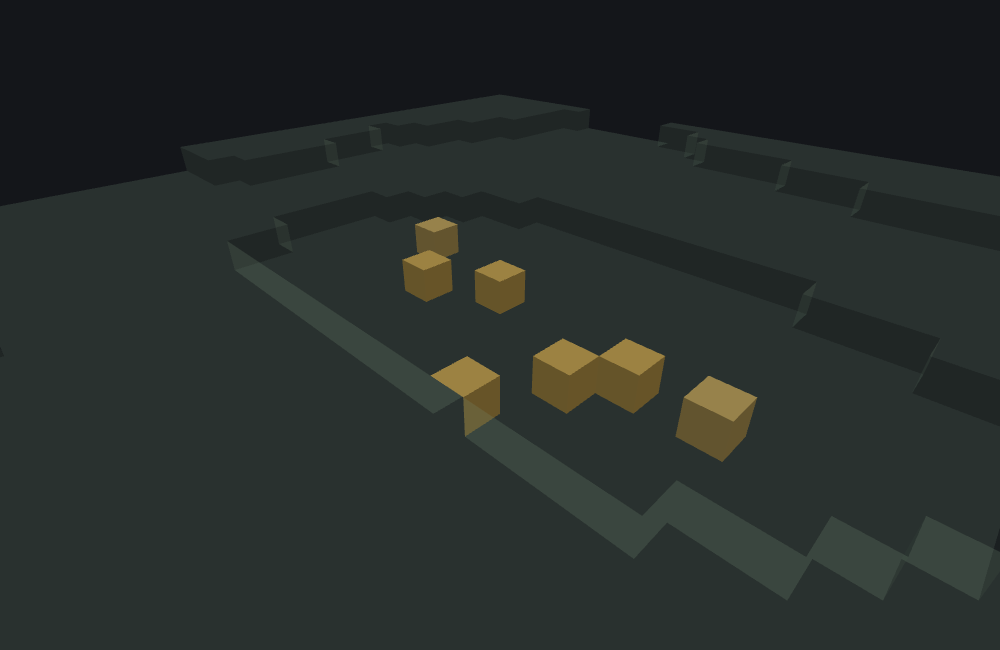
featurelab generate --pack <pack> --feature wiki:sequence_snap_then_scatter --env plains --seed 1 --origin 0,71,0Run against the plains preset with feature seed 1 from origin (0, 71, 0) — floating 8 blocks above the surface — 7 blocks are written, every one of them at world Y 63. The first entry scans down and places its pumpkin at (0, 63, 0); the patch around it is centred on that same (0, 63, 0), the floor the scan actually found, and not on the (0, 71, 0) the call was asked to start from. Six of the scatter's 14 rounds attach, five pumpkins and two jack o'lanterns in all, and the sequence reports (5, 63, 1) — its last successful entry's own result — as its own.
Swap one word in that file and the patch moves 8 blocks up
Change minecraft:sequence_feature to minecraft:aggregate_feature and nothing else, and the scatter runs at the original (0, 71, 0) — in open air, where its delegate's may_attach_to finds no grass and places nothing at all. The picture below is that experiment run properly, with a delegate that places wherever it is put so the comparison is about position rather than about success.
Fields
One key. "Default" is what the game uses when the key is absent — there is nothing optional here to default. The long-form account, in the editor's own words, is the field reference further down.
On the feature body
| Key | Required | Value | Default | What it does |
|---|---|---|---|---|
features | yes | array of feature identifiers, at least one | — | The features to run, in order. The first runs at the sequence's own origin; each one after a success runs at the position the previous successful entry returned. An empty array does not load at all, and the shorthand of a bare string instead of an array does not exist — see the aggregate page's note, which is the same schema rule. |
There is deliberately no early_out row: this type has no such key. Its schema accepts features and nothing else, so none of the three values an aggregate's early_out takes — "none", "first_success", "first_failure" — is available here. The behaviour the key would select is fixed at the last of the three: see where the list stops.
Common mistakes
| You wrote | What happens | Do instead |
|---|---|---|
"early_out": "none" on a sequence, to make the whole list run | The key is not in this type's schema. It is not applied, the walk still stops while nothing has succeeded yet, and the entries after a failed first one still do not run. | minecraft:aggregate_feature, which does have the key, if you want every entry to run regardless. |
| A sequence, expecting every entry to run | The list stops at the first entry that places nothing — as long as nothing has succeeded yet. One silent failure at the top costs you the entire list. | Put the entry most likely to succeed first, or use an aggregate. |
| A sequence, expecting it to stop at any failure | After something has succeeded, a later failure does not stop it: the running result is sticky. | There is no mode that does this. Order the list so the entry that must succeed is first. |
| A mistyped name as the first entry | The entry is skipped, nothing has succeeded, and the walk ends there. The whole sequence places nothing and reports nothing — it looks exactly like a probe that failed. | featurelab check reports the unresolved reference by name with a near-match suggestion. |
| Entry one is a plain single block feature, and you expected entry two to move | A single block returns the origin it was handed, so there is nothing to thread and entry two runs where entry one did. | Thread from a feature whose result actually differs from its input: a snap to surface, a search, a scatter. |
| A sequence around two features that both place at their origin, expecting two blocks in two places | The second one is handed the first one's returned position, which for a single block is the cell it just filled. It overwrites it. | Offset the second entry itself, or reach for an aggregate and offset one of them. |
"features": [] to switch a sequence off | The file does not load at all. | Remove the feature from whatever calls it. |
How it runs
Given an origin, the sequence runs these steps:
- Take the next entry in
features, in order, and resolve the name. A name no loaded file defines is skipped here, and the walk carries on to step 4. - Check that this sequence is allowed to place an internal feature — a fixed permission about the types the game reserves for itself, not a record of what is running. If it is not, the entry is refused and the running result is cleared, which also resets the threaded origin. A feature loaded from a pack always passes this check, and it does not stop a delegation loop.
- Run the entry — the first one, and every one while nothing has succeeded yet, at the sequence's own origin; every one after a success at the position the previous successful entry returned. If it places something, its returned position becomes the running result.
- Stop if nothing has succeeded yet. Otherwise go back to step 1.
- Report the running result as the sequence's own: the position of the last entry that succeeded, or nothing at all.
Only the origin is replaced in the threaded step; everything else an entry receives — the Molang scope above all — is passed on exactly as an aggregate passes it.
Each entry starts where the last one finished
This is the whole of the difference between the two composite types, and it is spatial, so here it is as a picture rather than as a paragraph. Both panels are the same JSON but for the type id: the same two entries in the same order, the same plains preset, the same feature seed 42, the same floating origin (0, 71, 0), the same volume and the same camera.
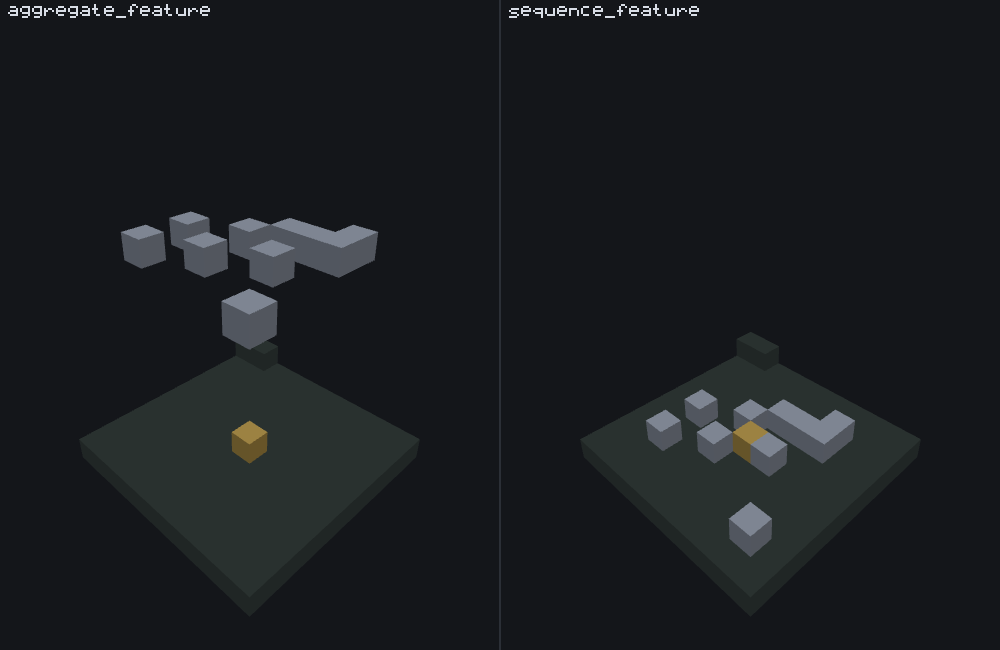
Each panel places the same 11 cells. One of them is the pumpkin at (0, 63, 0): entry one snaps to the floor and lands there in both panels, because entry one is handed the call's own origin either way. The other 10 are the second entry's markers, at identical x and z in both panels — the same rounds, the same offsets — and at two different heights:
| Where entry two ran | Where its markers landed | |
|---|---|---|
aggregate_feature | the call's own origin, (0, 71, 0) | world Y 71, floating in open air 8 blocks above the ground |
sequence_feature | (0, 63, 0), the position entry one returned | world Y 63, on the ground, around the pumpkin |
The 8-block gap is the whole figure. Nothing else in the two files differs.
The second entry here is a scatter of markers rather than the pumpkin patch the example above uses, and deliberately: its delegate attaches to nothing and places wherever it is put, so the aggregate panel shows the markers somewhere else rather than showing nothing. With the pumpkin patch in that slot, the aggregate's second entry would place nothing at all — its delegate needs grass below it and there is none at Y 71 — which is the real behaviour a pack meets, and is why "my second feature stopped working when I changed the type" is usually this. The fixtures behind the figure are aggseq_panel_aggregate.json, aggseq_panel_sequence.json and aggseq_panel_scatter.json, committed in the documentation's own pack under docs/wiki/tools/figure-fixtures/features/.
Which entries are worth threading from is a question about the delegate, not about the sequence: what a feature returns is part of that type's own contract. A snap to surface returns wherever its scan landed. A search returns the position it committed to. A scatter returns its last attaching round, which is somewhere in its spread rather than at its centre. A single block returns the origin it was handed, so threading from one changes nothing.
Where the list stops
A sequence is permanently in the mode an aggregate spells "early_out": "first_failure", and it has no key to change it. After every entry, the walk asks one question — has anything succeeded yet — and stops if the answer is no. Read the two halves separately, because they behave quite differently:
Before the first success, the list is fragile. If entry one places nothing, entry two is never asked. This is the type's most useful property rather than a hazard, and it is how you write a conditional without a condition: make the first entry a cheap probe — a single block feature whose may_replace or may_attach_to describes the ground you are willing to build on — and everything after it runs only where that probe could place. A probe that fails ends the call.
After the first success, the list is hard to stop. A later entry that places nothing leaves the running result alone, so the walk carries on to the end. The only thing that empties it again mid-walk is an entry refused outright by the internal-feature check — which a pack's own features always pass — and that also resets the threading to the original origin and, if it is the last thing to happen, makes the whole call report nothing despite the earlier success.
An unresolved first entry ends the sequence, silently
A name no loaded file defines is skipped rather than reported — the same as in an aggregate — but here the consequence is different. Skipping leaves nothing succeeded, so the walk stops at once and the sequence places nothing at all, at every seed, in every biome. A typo at the top of the list is indistinguishable in the world from a probe that refused.
featurelab check reports it by name without running anything, and featurelab generate --profile names both the unresolved entry and the stop it caused, with the count of entries skipped after it.
Field reference
The long-form account of every key, generated from the editor's own catalogue — the same text the Feature Lab node editor shows in its ? pane and on hover, with the schema facts (required, kind, absent-key default) the editor's forms are built from. The table above is the summary.
This type has no fields of its own beyond its delegation keys: everything it accepts is a reference to another feature, drawn on the graph as a connection rather than a form field.
features
required · array of feature identifiers, at least one · edited on the connections, not in the form
The features this sequence runs, in order, each one starting where the last one finished.
The first entry runs at the sequence's own origin. Every entry after a success runs at the position the previous successful entry RETURNED, which for a snap-to-surface or a scatter is not the position it was asked to start from. Until something succeeds -- and again after an entry is refused outright -- the original origin is used. Because a sequence always stops while nothing has succeeded yet, an entry no loaded file defines ends the list there instead of being skipped.
What the bench does differently
Nothing specific to this type: featurelab implements minecraft:sequence_feature in full, and its coverage entry carries no exception. The bench's additions are the same ones an aggregate gets, and they matter more here, because a sequence that stops early leaves nothing in the world to look at:
featurelab generate --profilenames the entry that ended the walk and how many entries were skipped after it, in the sequence's own profile row. That is the difference between "my sequence does nothing" and "entry one placed nothing, so the other three were never asked".featurelab generate'sdiagnosticsname the delegation chain for every refusal underneath the sequence, position by position.featurelab checknever runs a placement, so it will tell you that an entry is unresolved and nothing about whether the first entry would have succeeded.- Delegations nested more than 4096 deep stop the placement with an error diagnostic beginning
delegation depth limit hit, and the result is marked partial. The game has no such limit: a sequence that reaches itself again through one of its entries keeps recursing for as long as every link keeps placing. The limit is a count, so a run that hits it hits it at the same point every time; it exists so a loop in which nothing ever declines cannot crash the tool. See delegation loops.
Advanced: what a sequence spends
You do not need this section to use a sequence. It is for reading a preview value for value against the game, or for reproducing the engine exactly. RNG and determinism is the model these numbers fit into, and the aggregate page's own advanced section covers what the two types share; this is the part that is only true here.
A sequence takes no random value of its own — zero draws. Threading an origin is arithmetic, and the stop test reads a value it already has. Every draw spent under a sequence belongs to a delegate.
Two consequences are specific to this type:
- A stopped list stops spending. When the walk ends because nothing has succeeded yet, every entry after it is skipped, and none of them takes a value. So whether a probe succeeds decides not only what this sequence places but where the next feature's draws land — a sibling of this sequence, further down the caller's own list, is placed differently depending on whether a probe three levels down passed. This is the one type where a placement failure has a larger effect on the rest of the world than a placement success.
- Threading changes positions, not draws. The entries after a success are given a different origin, not a different stream position: they take exactly the values they would have taken at the original origin, and the offsets those values encode are simply measured from somewhere else. An aggregate and a sequence over the same list at the same seed therefore spend the same values in the same order, as long as the same entries succeed in both — which is why the figure's two panels place their markers at identical x and z and differ only in Y.
See also
- Aggregate feature — the same list walk with every entry at one origin, and the page that carries what the two types share: the running result, the three
early_outmodes, and the rules on thefeaturesarray itself. - Snap to surface and search — the two delegate types whose returned position is worth threading, and the reason a sequence exists at all.
- Scatter feature and single block feature — the other two delegates in this page's example, and the second of them is what returns its own input unchanged.
- Weighted random feature — the Proxy feature that picks exactly one entry from a list instead of walking it.
- Feature delegation and composite features — what happens when a sequence is reached again from inside one of its own entries, and what a delegating feature does and does not hand down.
How this page was checked
Everything above is a statement about Bedrock 1.26.60.22, and holds for 1.26.50.24 and 1.26.40.26 too: this type's JSON surface — one key, no early_out, no default to state — and its behaviour are identical in all three.
The threading rule, the fallback to the original origin while nothing has succeeded, the permanent stop condition and the absence of an early_out key are stated as facts about the game. The worked example was run end to end and its result read back out of featurelab generate: 7 blocks, all at world Y 63, the first at (0, 63, 0) from a call that began at (0, 71, 0), 6 of the scatter's 14 rounds attaching, and (5, 63, 1) reported as the call's own result. Both images were rendered from exactly those results by the documentation's own image pipeline, which runs the real engine against the fixtures and the documentation's own pack with a fixed seed and a deterministic camera, so re-running either reproduces it byte for byte.
The figure was read against the runs behind it rather than described from the JSON: 11 changed cells per panel, the shared pumpkin at (0, 63, 0) in both, and the 10 markers at identical x and z at world Y 71 on one side and world Y 63 on the other. The pipeline additionally refuses a figure whose panels come out nearly identical; this pair differs over 7.7% of its panel area. That the sequence ends at an unresolved or failing first entry while an aggregate over the same two entries carries on was reproduced as a pair of two-entry fixtures at one origin and one seed, read back off the placed-block count and the --profile stop list, and that a early_out written on a sequence changes nothing was reproduced the same way.
That the game puts no cap on a sequence reaching itself again was checked in game on 1.26.60.22, with a sequence of a single gold block followed by a one-iteration scatter, one block up, whose delegate was the sequence itself. It built a 19-block gold column that stopped only where the gold block met a stone block placed in its way; a second run went well over 100 levels with no limit appearing.