Geode feature
minecraft:geode_feature builds a lumpy ball of concentric shells around its origin, usually hollow, usually with a crack cut through one side. It is the type behind vanilla's amethyst geodes, and it is the one to reach for whenever you want a buried pocket with a lining: a crystal cave, an egg, a nest of ore in a rind of something else, a hollow boulder.
It is a Scene feature: it decides its own shape from a handful of randomly placed points and then writes every block itself, with no delegation. There is no places_feature here and nothing you name in it is a feature — all five layer keys are blocks, and inner_placements is a list of blocks too.
You do not need one for a plain lump of a single block, which is what an ore feature is for. What a geode buys you is layers: five of them, in a fixed order from the outside in, each its own block.
Start here: a complete example
One file. Every numeric field here is vanilla's own amethyst geode configuration verbatim, except inner_placements, cut to one entry so the picture reads as one block rather than four bud sizes competing for attention.
features/amethyst_geode.json{
"format_version": "1.21.110",
"minecraft:geode_feature": {
"description": { "identifier": "wiki:amethyst_geode" },
"filler": "minecraft:air",
"inner_layer": "minecraft:amethyst_block",
"alternate_inner_layer": "minecraft:calcite",
"middle_layer": "minecraft:calcite",
"outer_layer": "minecraft:smooth_basalt",
"inner_placements": ["minecraft:amethyst_cluster"],
"min_outer_wall_distance": 4,
"max_outer_wall_distance": 6,
"min_distribution_points": 3,
"max_distribution_points": 4,
"min_point_offset": 1,
"max_point_offset": 2,
"max_radius": 16,
"crack_point_offset": 2,
"generate_crack_chance": 0.95,
"base_crack_size": 2.0,
"noise_multiplier": 0.05,
"use_potential_placements_chance": 0.35,
"use_alternate_layer0_chance": 0.083,
"placements_require_layer0_alternate": true,
"invalid_blocks_threshold": 1
}
}What each choice buys you:
- The five layer keys are the geode, read outside in:
outer_layerbasalt,middle_layercalcite, theninner_layer/alternate_inner_layeramethyst-or-calcite, around afillerof air. That is a real geode's cross-section, and swapping those five blocks is the whole of restyling this type. min_outer_wall_distance/max_outer_wall_distanceis the size knob. It is[4, 6]here, which gives 4 or 5 — never 6. See how a range is read, which is not what the field names suggest.inner_placementsis the budding blocks. They are grown afterwards, onto the walls of the hollow centre, and only where two chance rolls and a wall check all allow it.max_radius: 16is not a size. It is how far out the feature bothers to look, and it only ever clips a geode that the other fields made bigger.
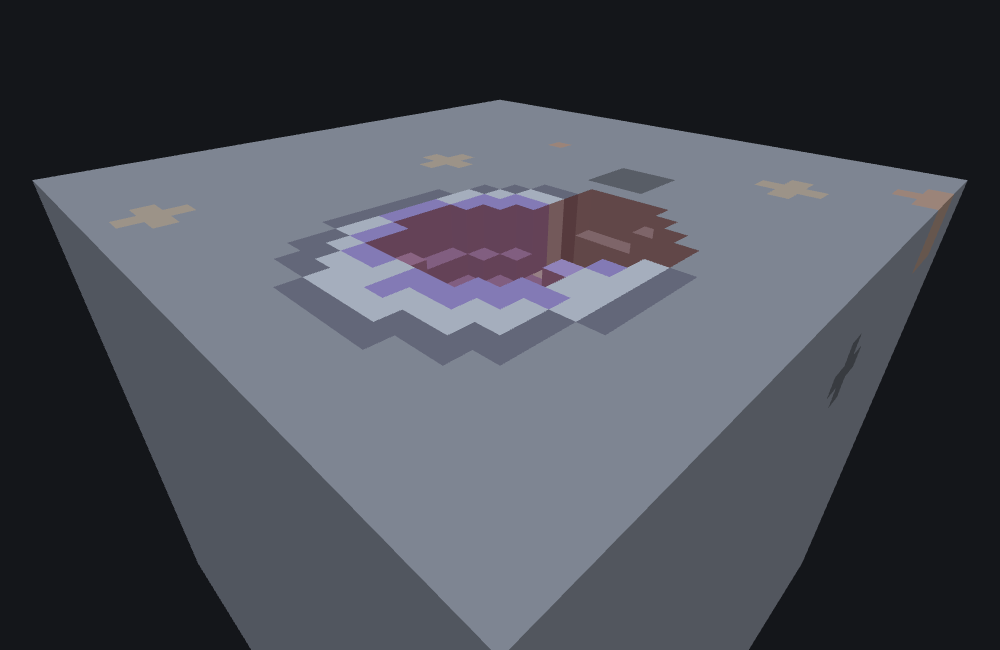
featurelab generate --pack <pack> --feature wiki:amethyst_geode --env underground_stone --seed 4 --origin 0,32,0Run against the underground_stone preset (solid stone, no caves) with feature seed 4 and origin (0, 32, 0), this geode changes 1,353 cells spanning world (-1..11, 30..42, -2..12): 383 smooth_basalt, 319 calcite, 206 amethyst_block, 434 cells of hollow-centre and crack air, and 11 amethyst_cluster buds at this seed.
The image is a cutaway, and that is a viewing choice
A geode this deep in solid rock is sealed on every side — every one of its cells borders either more geode or more stone — so an unsliced render would show nothing but the opaque outer_layer shell, the same problem the ore feature's vein has. The picture above is cut at the geode's own vertical midpoint, world Y 36, with the surrounding rock drawn solid, which exposes a horizontal cross-section straight through the shells: hollow centre, inner_layer ring, middle_layer ring, outer_layer ring, from the middle out. Nothing about what the feature placed changes.
Fields
Twenty-one keys, and every one of them is required except inner_placements. There is no partial geode definition: a missing key is a build error naming it. "Default" below is therefore only meaningful for the one optional key. The long-form account of every key, in the editor's own words, is the field reference further down; these tables are the short version.
The five layers, and the buds
Read top to bottom, these are the geode from the outside in.
| Key | Required | Value | What it does |
|---|---|---|---|
outer_layer | yes | block descriptor | The outermost shell — the rind. |
middle_layer | yes | block descriptor | The shell inside that. |
inner_layer | yes | block descriptor | The innermost solid shell, the one the buds grow off. |
alternate_inner_layer | yes | block descriptor | A second block that some cells of the innermost shell become instead, chosen per cell by use_alternate_layer0_chance. Write it the same as inner_layer if you do not want two. |
filler | yes | block descriptor | The middle. minecraft:air makes the geode hollow; a solid block makes it a layered boulder. |
inner_placements | no — the only optional key | array of block descriptors | The buds grown on the walls of the middle afterwards. Picked from evenly — there is no weight field here, unlike weighted random features or places_block's own weighted list. An omitted or empty list simply means no buds. See buds. |
Shape and size
| Key | Required | Value | Range | What it does |
|---|---|---|---|---|
min_distribution_points | yes | integer | [1, 10] | The low end of how many points the blob is built around. More points make it lumpier and less spherical; fewer make it a cleaner ball. |
max_distribution_points | yes | integer | [1, 20] | The high end — never reached. See how a range is read. Vanilla's [3, 4] is always 3. |
min_outer_wall_distance | yes | integer | [1, 10] | The low end of how far each point is pushed from the origin, independently on X, Y and Z. This is the dominant size control. |
max_outer_wall_distance | yes | integer | [1, 20] | The high end — never reached. Vanilla's [4, 6] gives 4 or 5. It also divides into the three outer shell thresholds, so lowering it grows the geode as well as shrinking the spread. |
min_point_offset | yes | integer | [0, 10] | The low end of a per-point fudge that distorts the shells without moving the point. |
max_point_offset | yes | integer | [0, 10] | The high end — never reached, and if it equals min_point_offset the offset is 0, not that value. See the two traps. |
max_radius | yes | integer | not checked | How far from the origin the feature looks for cells at all. It is a bound, not a size: it cannot make a geode bigger, only clip one. |
noise_multiplier | yes | number | not checked | How much the shell boundaries and the crack edge are roughened. 0 gives clean mathematical bands; vanilla's 0.05 gives visible roughness without losing the shape. The effect also scales with the number of points. |
invalid_blocks_threshold | yes | integer | not checked | How many of the geode's points may land in minecraft:bedrock, minecraft:packed_ice or minecraft:blue_ice before the whole geode is abandoned. See invalid_blocks_threshold. |
The crack keys
| Key | Required | Value | Range | What it does |
|---|---|---|---|---|
crack_point_offset | yes | integer | [0, 10] | How wide the crack reads. This one does work — it enters the crack's own distance test the way a point's offset enters the shell density. |
generate_crack_chance | yes | number | [0.0, 1.0] | Nothing, at placement. Validated when the file loads and then never read. See the two lying fields. |
base_crack_size | yes | number | [0.0, 5.0] | Nothing, at placement. Same. |
The buds' three gates
| Key | Required | Value | Range | What it does |
|---|---|---|---|---|
use_alternate_layer0_chance | yes | number | [0.0, 1.0] | Per cell of the innermost shell: the chance it becomes alternate_inner_layer instead of inner_layer. |
placements_require_layer0_alternate | yes | boolean | — | When true, a bud is only ever attempted on a cell that became alternate_inner_layer. When false, every innermost-shell cell gets a chance. |
use_potential_placements_chance | yes | number | [0.0, 1.0] | Per cell that got past the gate above: the chance a bud is attempted there at all. |
Common mistakes
| You wrote | What happens | Do instead |
|---|---|---|
"min_distribution_points": 3, "max_distribution_points": 4 expecting 3 or 4 | Always 3. Both ends of every min/max pair here behave as from min, up to but not including max. | [3, 5] for a genuine 3-or-4. |
"min_outer_wall_distance": 4, "max_outer_wall_distance": 6 expecting up to 6 | 4 or 5. | [4, 7]. |
"min_point_offset": 2, "max_point_offset": 2 to pin the offset at 2 | The offset is 0. A min/max pair that is equal means no offset at all, whatever the number is — and this is the one pair where an equal pair does not give you min. | [2, 3], which pins it at 2. |
"generate_crack_chance": 0.1 to make cracks rare | No effect whatsoever. The roll is against a fixed value this field does not touch, and a crack appears roughly 19 times in 20 however you set it. | Nothing here will do it. If you need an uncracked geode, that is not a shape this type can be asked for. |
"base_crack_size": 4.0 for a wider crack | No effect. The crack's width comes from the number of points instead. | crack_point_offset, which really does widen it. |
Raising max_radius to grow a geode | It is only how far the feature looks. A geode already inside the old radius does not change at all. | min/max_outer_wall_distance, and lower the max if you want the shells thicker. |
"invalid_blocks_threshold": 0 meaning "one bad point is tolerable" | The threshold is the number tolerated, so 0 abandons the geode on the first point that lands in bedrock or ice. | 1 tolerates exactly one, 2 two. |
Weights inside inner_placements | There is no weight field. Every entry is equally likely. | List a block twice if you want it twice as often. |
"placements_require_layer0_alternate": true with a small use_alternate_layer0_chance | Buds become very rare: only the few cells that took the alternate block are even eligible, and each of those still has to pass use_potential_placements_chance. Vanilla's 0.083 × 0.35 is the reason a real geode has a handful of clusters, not a lining of them. | Set it false if you want buds all round the cavity. |
A filler that is not air, with inner_placements set | Buds grow into the first neighbouring cell that is air or water. With a solid filler there is usually no such cell, so nothing buds. | Hollow the geode, or drop inner_placements. |
How it runs
- Pick the number of points from
min/max_distribution_points. - Work out the five thresholds that separate the bands, from that number and
max_outer_wall_distance, and roll once for whether this geode cracks. - Place the points. Each one is pushed away from the origin by an independently chosen distance on X, then Y, then Z, and given its own offset. If a point lands in bedrock or one of the two ices, it still counts as a point — unless the tolerance is already used up, in which case the whole geode is abandoned on the spot and nothing is written.
- If the geode cracks, pick one of four fixed crack shapes.
- Walk every cell within
max_radiusand give it one density number: how close it is to the points, plus a noise sample. That number alone decides which band the cell is in, and therefore which block it gets — or whether it is carved to air by the crack. - Grow the buds. Every cell of the innermost shell that passed both chance rolls in step 5 is revisited, one
inner_placementsentry is picked for it, and the bud is written on the first neighbouring cell that is open — not on the shell cell itself.
The concentric-shell model
A geode is not a stack of literal spheres. Every cell within max_radius of the origin gets a single density value — how close it is to all of the geode's points at once, plus a noise sample scaled by noise_multiplier and by how many points there are — and that one number decides which shell the cell falls into.
Because density rises as a cell gets closer to any point rather than just the nearest one, the result is an irregular, lumpy blob loosely centred on the origin rather than a perfect sphere. A handful of points, offset from each other and from the origin, is what produces the recognisable geode silhouette instead of one clean ball.
Five bands, tested loosest first — "too far away" always wins before anything else is considered:
| Density | Result |
|---|---|
| below the loosest threshold | nothing — outside the geode entirely |
| next band up | outer_layer |
| next band up | middle_layer |
| next band up | the innermost shell — inner_layer or alternate_inner_layer, and possibly a bud |
| at or above the tightest threshold | filler — the middle |
The three thresholds separating "nothing" from outer_layer, middle_layer and the innermost shell all fall as the number of points rises and as max_outer_wall_distance falls, so those two fields move the shell boundaries as well as the spread. The innermost threshold, the one that turns a cell into filler, is a fixed constant that no field moves at all — which is why a geode's hollow centre keeps roughly the same size while its shells grow around it.
You cannot work out which block a given cell gets by hand
Two things make the density arithmetic unreproducible on paper: the distance term is the game's fast approximate reciprocal square root rather than an exact one, and the whole cascade — the running total, the noise term, every threshold it is compared against — is single precision. Each effect is tiny per term, but they accumulate across the sum, and the comparison at the end is a hard threshold. A cell sitting right on a shell boundary can land on either side of it. The model above tells you the shape; only a run tells you the block.
How a range is read, and the two traps in it
Every min/max pair on this page — the point count, the wall distance, the point offset — is read the same way: from min, up to but not including max.
That is not what the field names suggest, and it is the single commonest way a geode comes out different from the one that was written. Vanilla's own amethyst geode says min_distribution_points: 3, max_distribution_points: 4 and gets three points, every time, at every seed. It says min_outer_wall_distance: 4, max_outer_wall_distance: 6 and gets 4 or 5, never 6. It says min_point_offset: 1, max_point_offset: 2 and gets 1, every time.
Two committed fixtures show it directly. Both are one-point geodes, so the whole blob is a single ball centred on that one point, and the point's position can be read straight off the result:
featurelab generate --pack <pack> --feature wiki:geode_wall_5_6 --env underground_stone --seed 1 --origin 0,32,0
featurelab generate --pack <pack> --feature wiki:geode_wall_6_7 --env underground_stone --seed 1 --origin 0,32,0
wiki:geode_wall_5_6 writes min_outer_wall_distance: 5, max_outer_wall_distance: 6 and puts its 33 cells over world x/z 3 to 7 and y 35 to 39 — a ball centred on (5, 37, 5), which is the origin plus exactly min on every axis. wiki:geode_wall_6_7 differs in those two numbers only and centres on (6, 38, 6). Neither moves by a single block when the seed changes, because with max one above min there is nothing left to choose.
The two traps
An equal pair means min — except for the point offset, where it means zero. min_distribution_points: 3, max_distribution_points: 3 gives three points, and min_outer_wall_distance: 5, max_outer_wall_distance: 5 gives 5. But min_point_offset: 2, max_point_offset: 2 gives an offset of 0: that one pair is skipped entirely rather than collapsed to its min. The third committed fixture is wiki:geode_wall_5_6 with nothing changed but those two numbers, set to 2 and 2:
featurelab generate --pack <pack> --feature wiki:geode_offset_pinned --env underground_stone --seed 1 --origin 0,32,0It produces exactly the same geode as wiki:geode_wall_5_6, which writes 0 and 0 — same cells, same blocks, at every seed tried. If you want a point offset of 2, write [2, 3].
A one-wide pair is not free. [5, 6] and [5, 5] both give you 5, but they are not interchangeable: the first still asks for a random number it then has no use for, and everything the geode decides afterwards shifts. Two geodes whose points land in exactly the same cells can still come out with different shells and a different crack. If you are pinning a value, pin it with min == max.
invalid_blocks_threshold
As each point is placed, the block already at its position is checked against a short list a geode can never anchor in: minecraft:bedrock, minecraft:packed_ice, minecraft:blue_ice.
A point that lands on one of those while the tolerance still has room is kept anyway. It is not discarded, moved or re-placed, and it goes on to pull the density field around exactly like any other point. The moment a point lands on one of the three with the tolerance already used up, the whole geode stops right there and writes nothing.
So the field is the number of bad points tolerated: invalid_blocks_threshold: 1 allows exactly one of them, not zero, and the geode is abandoned on the second. The abort is immediate rather than at the end of the loop — the geode does not go on to place the points it had left.
generate_crack_chance and base_crack_size
Neither field controls what its name suggests
Both are required by the schema and both are range-checked when the file loads — generate_crack_chance in [0.0, 1.0], base_crack_size in [0.0, 5.0] — but at placement time:
- The roll that decides whether a crack forms is against a fixed value that this field does not feed. Setting
generate_crack_chanceto0.1or to1.0makes no difference: a crack appears about 95 times in 100 either way. Microsoft's own worked example happens to set the field to0.95, which is why this is easy to miss. base_crack_sizeis not read at placement at all. The crack's width comes from the geode's own point count instead.
This is behaviour of the game, not a limitation of this tool, and it is specific to the version this page pins rather than a permanent fact about the format.
The crack itself has a fixed geometry, not a configurable one: a three-point line at origin.Y + 7, origin.Y + 5 and origin.Y + 1, with one of four fixed X/Z shapes chosen for it — offset along X only, along Z only, diagonally along both, or not offset at all, straight up through the origin. How far that offset reaches is not configurable either; it is an odd number worked out from the number of points.
A cell is carved to air when its own distance to that line clears a threshold and its density is below the filler threshold — so a crack never carves through the hollow centre, and never reaches outside the geode. The result reads as a visible notch through the outer shells, cut where the density field alone would have placed solid material. Two things feed that test besides the line:
crack_point_offsetenters the line-distance sum exactly the way a point's own offset enters the shell density, so it does have a real, visible effect on how wide the crack reads — even though the two fields named "chance" and "size" beside it in the schema do not.noise_multiplierroughens the crack's edges as well as the shell boundaries, because the same noise term is added to both. The threshold the crack sum is compared against also carries a small random component chosen once per geode, so two geodes with identical fields do not crack to identical widths.
inner_placements — the budding blocks
inner_placements is a plain array of block descriptors, picked from evenly: there is no weight field, and vanilla's own amethyst geode lists its four candidates — small, medium and large bud, plus the cluster — the same unweighted way.
A bud is only attempted on a cell of the innermost shell that gets past two gates first:
use_alternate_layer0_chancedecides, per cell, whether that cell becomesalternate_inner_layer(roll succeeds) orinner_layer(roll fails).placements_require_layer0_alternate, whentrue, restricts buds to the cells that becamealternate_inner_layer; cells that stayedinner_layernever get one. Whenfalse, every innermost-shell cell is eligible regardless of which block it became. This matches Microsoft's own wording for the field — "potential placement blocks will only be placed on the alternate layer0 blocks that get placed" — exactly.use_potential_placements_chanceis then the per-cell chance that a bud is attempted at all.
A cell that passes all of that becomes a candidate position, not an immediate bud. Budding is resolved afterwards, once per candidate, by looking at that position's six neighbours in a fixed order — up, down, north, south, west, east — for the first one that is air or water. The picked block is written at that neighbour, not at the shell cell, facing back toward the cell it budded from — the same "grows toward open space" behaviour real budding amethyst has. A candidate with no open neighbour simply grows nothing.
Field reference
The long-form account of every key, generated from the editor's own catalogue — the same text the Feature Lab node editor shows in its ? pane and on hover, with the schema facts (required, kind, bounds) the editor's forms are built from. The tables above are the summary; where the two differ in precision, the tables are the measured version.
filler
required · block
The block filling the hollow core of the geode.
Usually air, which is what makes the geode hollow.
inner_layer
required · block
The block lining the inside of the shell.
Each lining cell is either this or alternate_inner_layer, decided per cell by use_alternate_layer0_chance.
alternate_inner_layer
required · block
The second lining block, mixed into the inner layer.
It is also the layer inner_placements can grow on when placements_require_layer0_alternate is set.
middle_layer
required · block
The block of the shell's middle band.
Sits between the lining and the outer skin.
outer_layer
required · block
The block of the shell's outermost band.
This is the surface the geode presents to the surrounding stone.
inner_placements
optional · blockList
Blocks scattered on the inside of the lining -- the crystals.
One entry is picked at random per chosen position, and the position still has to be able to hold it.
min_outer_wall_distance
required · integer · range [1, 10]
The smallest offset a lump may take from the geode's centre.
Each lump is offset by a draw from this UP TO BUT NOT INCLUDING max_outer_wall_distance, made separately for x, y and z -- so 4/6 gives 4 or 5, and 4/5 is always 4.
max_outer_wall_distance
required · integer · range [1, 20]
The largest offset a lump may take from the geode's centre.
It does double duty: it also divides into the number of lumps to set the shell thresholds, so raising it changes the thickness of the shell as well as how far the lumps spread.
min_distribution_points
required · integer · range [1, 10]
The fewest lumps the geode is built from.
Drawn once per geode, from this UP TO BUT NOT INCLUDING max_distribution_points -- vanilla's 3/4 is always 3, and 4/6 gives 4 or 5, never 6.
max_distribution_points
required · integer · range [1, 20]
The most lumps the geode is built from.
More points make a lumpier, less spherical geode -- but this value is never itself drawn: the count stops one short of it, so 4 is the most a 3/5 pair ever produces.
min_point_offset
required · integer · range [0, 10]
The low end of a per-lump value that varies how strongly each lump shapes the geode.
Drawn once per lump, from this UP TO BUT NOT INCLUDING max_point_offset. Unless max is strictly above min there is no draw at all and every lump takes 0 -- not this value.
max_point_offset
required · integer · range [0, 10]
The high end of a per-lump value that varies how strongly each lump shapes the geode.
Drawn once per lump, from min_point_offset UP TO BUT NOT INCLUDING this. Unless it is strictly above min there is no draw at all and every lump takes 0, whatever min says.
max_radius
required · integer
How far from the origin the geode is allowed to reach.
It is the size of the box that gets examined, not the size of the geode: every column within it is tested and most of them come out empty. Raising it costs work whether or not the geode gets any bigger.
crack_point_offset
required · integer · range [0, 10]
Widens the opening cracked into the geode's shell.
Added to the distance test that decides which cells the crack carves away.
generate_crack_chance
required · number · range [0, 1]
Schema-required and validated, but not read anywhere in the engine's placement routine that has been located -- the crack roll it looks like it controls is a hardcoded 0.95 compare.
base_crack_size
required · number · range [0, 5]
Schema-required and validated, but not read during placement -- see generate_crack_chance.
noise_multiplier
required · number
How strongly noise distorts the shell.
At 0 the geode is a smooth set of merged spheres; raising it makes the boundary between the layers ragged.
use_potential_placements_chance
required · number · range [0, 1]
Chance that a lining cell is put forward as somewhere to grow inner_placements.
Rolled per lining cell, and only within the lining band.
use_alternate_layer0_chance
required · number · range [0, 1]
Chance that a lining cell uses alternate_inner_layer instead of inner_layer.
Rolled per lining cell, which is what mixes the two blocks through the lining.
placements_require_layer0_alternate
required · boolean
Restricts inner_placements to cells that came out as the alternate lining block.
With it off, both lining blocks can carry them.
invalid_blocks_threshold
required · integer
How many unusable distribution points to tolerate before abandoning the geode.
Reaching it stops the whole placement on the spot -- nothing is built. Staying below it is harmless: an unusable point is still kept and still shapes the geode.
What the bench does differently
featurelab implements the shells, the crack, the whole placement order and the traversal, and the two lying fields above are the game's behaviour rather than anything missing here. One gap is real, and it is narrow.
- Whether a bud may attach to a cavity wall runs through the game's own per-block placement check, and one step of that check is not modelled. Two of the three steps are: the support test on the cell the bud grows from, and the block's own placement filter — which faces it accepts, and what it requires the anchor to be. A face failing either is skipped rather than budded. What is not modelled is the last step, a data-driven multi-block component that lets a block declare itself one part of a larger structure. None of the four blocks the game registers as amethyst clusters carries one, so for a vanilla
inner_placementslist the gap cannot change a single placement. - The disclosure is therefore narrow rather than constant. featurelab warns only when a pick resolves to a block outside those four, names the block, and says it at most once per geode placed — not once per bud, and not at all for a vanilla configuration. The warning says that where that block's buds end up here may not be where the game puts them.
inner_placementsis treated as optional. Every other key is required and a missing one is a build error. Whether the game's own schema also allows this one to be left out is not known, so featurelab accepts an omitted or empty list — read that as this tool's accepted behaviour, not as a claim about the game.- The geode-support check reads one block layer. The game checks both the primary and the legacy layer at a point's position; featurelab's world model has no such distinction, so it is one lookup.
featurelab checkreports a missing or out-of-range key and nothing else. It never runs a placement, so an abandoned geode, a bud with nowhere to grow and a field that quietly does nothing are all invisible to it; those arefeaturelab generate'sdiagnostics, and the preview panel's Diagnostics section.
Advanced: how the random values are spent
You do not need this section to build a geode. It is for reading a preview draw for draw against the game, or for reproducing the engine's behaviour exactly. RNG and determinism is the model these numbers fit into; this section is the geode's row in it.
A geode is by far the most expensive type in the system, and almost all of it is fixed cost. Before any of the schema-gated logic runs, Place unconditionally builds a noise generator out of the placement's own random stream — 2,608 advances, every geode, whatever its fields say. That generator is what the density formula's noise_multiplier term samples per cell. Everything else the type does is small change beside it.
The order, in full:
- The point count, one two-argument integer draw.
- The noise generator, 2,608 advances, unconditional, before any branch.
- The five thresholds. Four are pure arithmetic. The fifth needs a radius jitter, one float draw, and is computed after the point ratio is reset to zero for a geode of three points or fewer. Then one more float draw for the crack roll, compared against a hardcoded
0.95. - Per point, in order: the X distance, the Y distance, the Z distance, then — only when
max_point_offsetis strictly greater thanmin_point_offset— the point's own offset. The support check happens before the offset draw and spends nothing; a failure at or aboveinvalid_blocks_thresholdends the placement on the spot, so the offending point never spends its offset draw, is never stored, and no later point is drawn at all. Finishing the loop instead would spend values the game never spends. - The crack shape, one bounded draw over 4, only if the crack roll succeeded. None of the four shapes draws anything further.
- Per cell of the innermost shell: one float for the alternate-layer roll, unconditionally, and then one more for the potential-placements roll — but only when the first roll's outcome and
placements_require_layer0_alternateallow it. Both are inside that one density band; no other band draws anything. - Per candidate bud position: one bounded draw over the length of
inner_placements. The face scan and the placement check that follow it draw nothing, so a candidate that fails them still costs the pick.
The density formula
Per cell, the number every band is decided from is the sum over the geode's own points of 1/sqrt(distance² + offset), plus the noise sample multiplied by the point count and by noise_multiplier. The 1/sqrt(...) is the game's fast approximate reciprocal square root — the Quake bit hack, not a real reciprocal square root — and every value in the cascade, the running total included, is single precision. Both are why the shell model says the boundary cannot be worked out on paper.
The five thresholds are 1/sqrt(1.7) for filler, then 1/sqrt(r + 2.2), 1/sqrt(r + 3.2) and 1/sqrt(r + 4.2) for the three shells, where r is the point count divided by max_outer_wall_distance. They are decreasing in that order for any r at or above zero, which is what fixes the band order. The crack's own threshold is 1/sqrt(jitter + r) with r reset to zero for a geode of three points or fewer, and the jitter is the one float draw in step 3.
The range helper, and why it is not the ordinary one
Every two-argument integer range on this page is min + nextIntBound(max - min), with the draw skipped entirely when max <= min. That is uniform over [min, max - 1] — the maximum is exclusive, which is what the range section is about — and it is not the engine's ordinary int-range sampler, which vegetation patch features use for their own ranges. The two produce the same value but disagree on the draw at max - min == 1: the ordinary sampler skips the draw there, while this one still makes an always-zero nextIntBound(1) call. So a geode with a one-wide range spends a value that changes nothing and shifts everything after it, which is visible from outside: wiki:geode_wall_5_6 and a copy of it written 5 and 5 put their single point in exactly the same cell and still come out as different geodes — the same at seed 1, different at each of seeds 2 to 6.
The point offset is the exception, and it is a different mechanism: it is guarded by max_point_offset > min_point_offset before the helper is reached at all, so an equal pair spends nothing and yields 0 rather than min.
The traversal order
Not a plain ascending sweep, and the order is what decides which cell receives which float. X walks from the origin outward to +max_radius first, then from -1 back down to -max_radius, as two separate passes. For each X, Y does the identical up-then-down split around the origin. For each (X, Y), Z is a single ascending pass across the whole width.
The fixtures
The worked example is geode_amethyst.json, in the product's pack. The three range fixtures — geode_wall_5_6.json, geode_wall_6_7.json and geode_offset_pinned.json, one-point geodes whose single ball makes the point's own position readable off the result — were written for this page and are committed in the documentation's own pack, docs/wiki/tools/figure-fixtures/features/; pass that directory as --pack to reproduce the three commands above.
See also
- Ore feature — the other self-contained type that writes a whole lump in one call with no delegation, contrasted by shape: one ellipsoidal vein of one block, against concentric shells of five.
- Vegetation patch feature — the other Scene feature, which combines a footprint search with a delegated feature instead of writing its own blocks.
- Cave carver feature — a Carver that also builds a noise-driven shape out of a handful of randomly placed anchor points, and then removes blocks with it rather than layering them.
- Weighted random feature — what to read if you expected
inner_placementsto take weights. - RNG and determinism — the model the Advanced section above fits into, and why a geode's fixed noise cost matters to everything placed after it.
How this page was checked
Everything above is a statement about Bedrock 1.26.60.22, and holds for 1.26.50.24 and 1.26.40.26 too: this type's JSON surface and its whole placement are unchanged across the three, so nothing on this page splits between them.
The worked example was run end to end, and the block names, the cell counts and the extent quoted beside it were read back out of that run rather than predicted. The image was rendered from that exact result by the documentation's own image pipeline, sliced as the tip beside it describes.
The range behaviour is the part of this page that was re-measured rather than carried over, because the previous account of it was wrong in three places. min/max pairs here were described as inclusive of their maximum; they are not. Three committed fixtures were added to show it at the level a pack author can check: wiki:geode_wall_5_6 and wiki:geode_wall_6_7 are one-point geodes whose 33 cells centre on the origin plus exactly min on every axis, unchanged across five seeds, and wiki:geode_offset_pinned is the first of those two with min_point_offset and max_point_offset both set to 2, which produces a byte-identical result — the proof that an equal point-offset pair means zero. The same three corrections follow through to the description of vanilla's own configuration: it has three points and not "three to four", a wall distance of 4 or 5 and not "4 to 6", and a point offset of 1 and not "1 to 2".
What this page deliberately does not claim: base_crack_size having no effect is the absence of any use of the field rather than a value anyone can point at, which is a weaker kind of certainty than the fixed 0.95 the crack roll really is against, and the warning above says so in those terms. Whether the game's own schema requires inner_placements is not known, so the field tables state what featurelab accepts rather than what the game demands.